
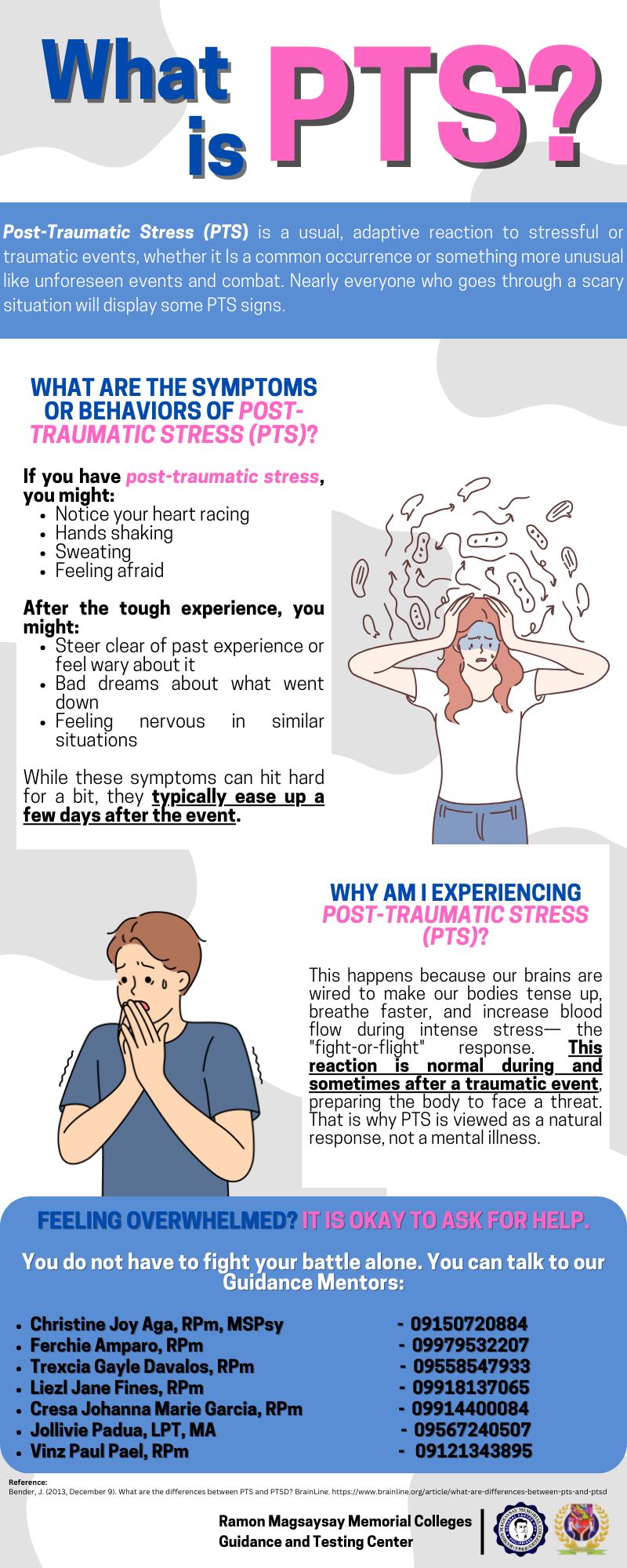
What is PTS? Post-Traumatic Stress (PTS) is a usual, adaptive reaction to stressful or traumatic events, whether it is a common occurrence or something more serious like unforeseen events or combat. Nearly everyone who goes through a frightening situation may display some PTS signs. What are the symptoms or behaviors of Post-Traumatic Stress (PTS)? If you have post-traumatic stress, you might: • Notice your heart racing • Hands shaking • Sweating • Feeling afraid After the tough experience, you might: • Steer clear of the past experience or feel wary about it • Have bad dreams about what happened • Feel nervous in similar situations While these symptoms can hit hard for a bit, they typically ease up a few days after the event. Why am I experiencing Post-Traumatic Stress (PTS)? This happens because our brains are wired to make our bodies tense up, breathe faster, and increase blood flow during intense stress — the “fight-or-flight” response. This reaction is normal during and sometimes after a traumatic event, preparing the body to face a threat. That is why PTS is viewed as a natural response, not a mental illness. Reference: Bender, J. (2013, December 9). What are the differences between PTS and PTSD? BrainLine. https://www.brainline.org/.../what-are-differences... Feeling overwhelmed? It is okay to ask for help. You do not have to fight your battle alone. You can talk to our Guidance Mentors: Christine Joy Aga, RPm, MSPsy – 09150720884 Ferchie Amparo, RPm – 09979532207 Trexcia Gayle Davalos, RPm – 09558547933 Liezl Jane Fines, RPm – 09918137065 Cresa Johanna Marie Garcia, RPm – 09914400084 Jollivie Padua, LPT, MA – 09567240507 Vinz Paul Pael, RPm – 09121343895
-
 College of Business Education
 College of Engineering and Technology
 College of Arts and Sciences
 College of Criminal Justice
 College of Teacher Education
 College of Allied Health Sciences
 Expanded Tertiary Education Equivalency and Accreditation Program
 Graduate School Program
 Technical Vocational Education